Drone Flux Measurement (DFM™)
A new highly accurate drone-based method of measuring fugitive climate gases from different sources.
We help find and quantify emissions
The DFM™ Method, developed and patented by Explicit, offers a highly accurate, drone-based approach for measuring fugitive gases from various critical sources.
Based on an advanced sensor and sampling design, the method enables the quantification of individual site and source-level contributions, as well as flare destruction removal efficiency estimations in compliance with OGMP 2.0 guidelines and aligned with the EU Methane Regulation.
Key benefits
Single-person set up
Easy deployment over land and sea
No interference with site operations
Independence from mean wind
High accuracy and low detection limit
Visualisations to support source localisation
ISO accredited method, patented technology
From climate gas to emissions result
Combining sensors, software, and lab services in one integrated solution, Explicit provides a full ISO 17025-compliant service.

Site survey and sampling plan
Preliminary analysis of the site, identification of possible sources, risk zones, feasible flight paths, etc. and organisation of the campaign.

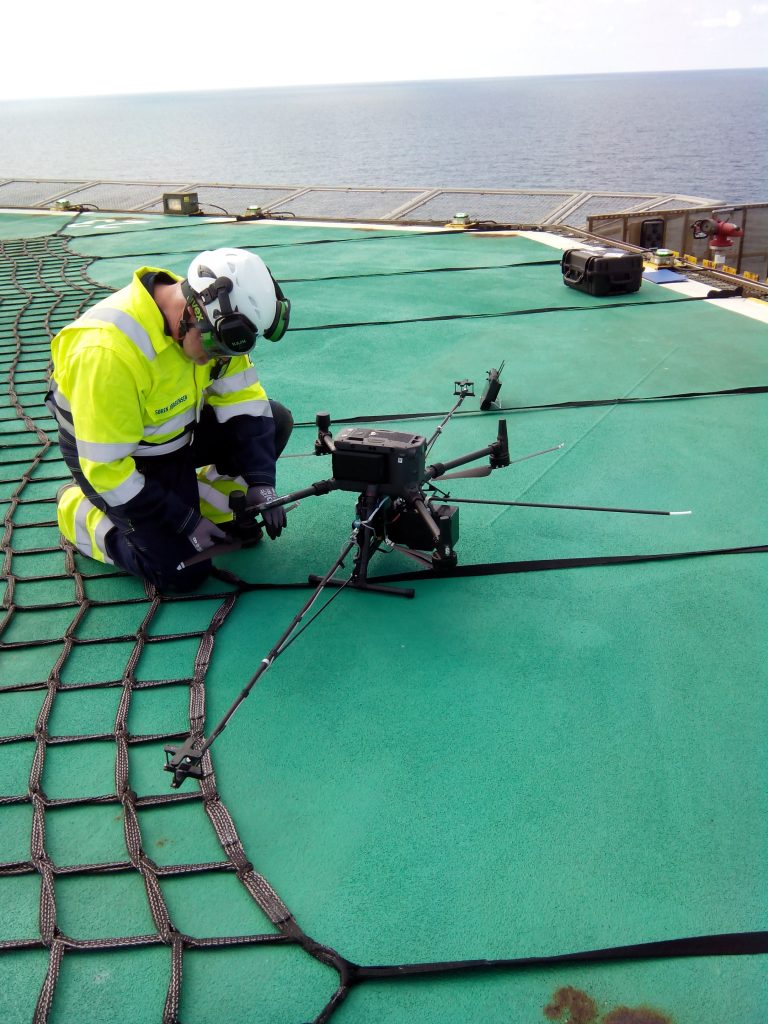
Drone set-up and data collection
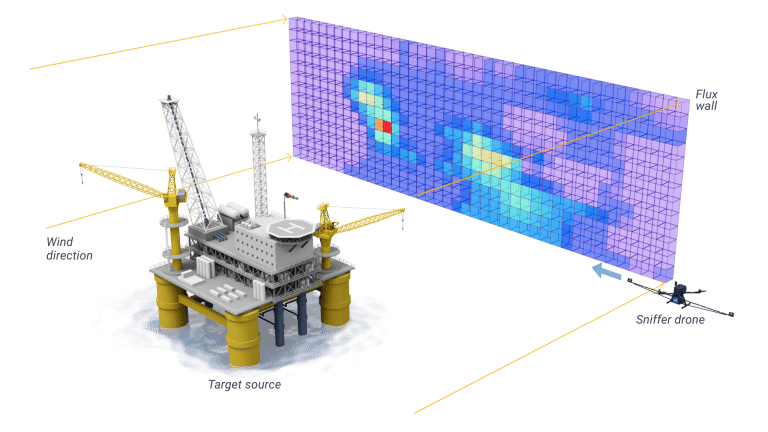
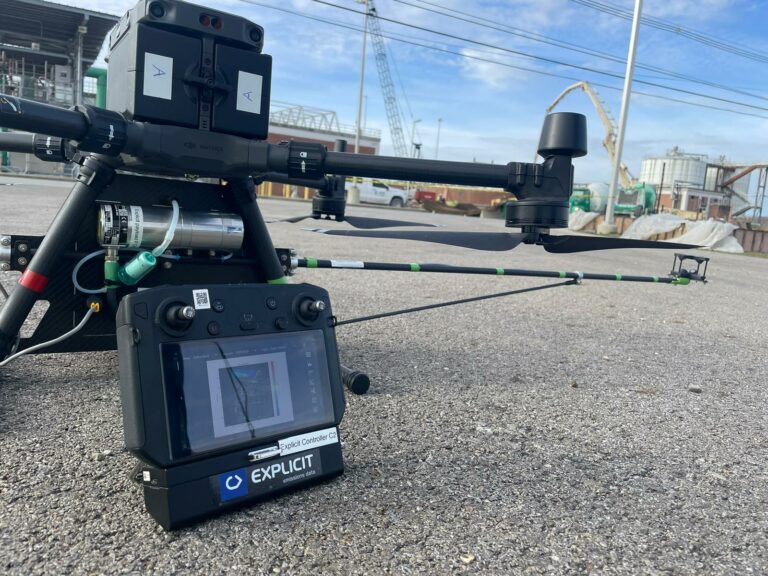
Gas and wind sensors are integrated on the drone. Through an adaptive flight pattern, the drone flies a vertical wall downwind from the site of interest, collecting thousands of data points.
Preliminary and final analysis
An automated analysis provides the pilot with real-time feedback on the flight. Once the data collection is concluded, the analyst processes the data.

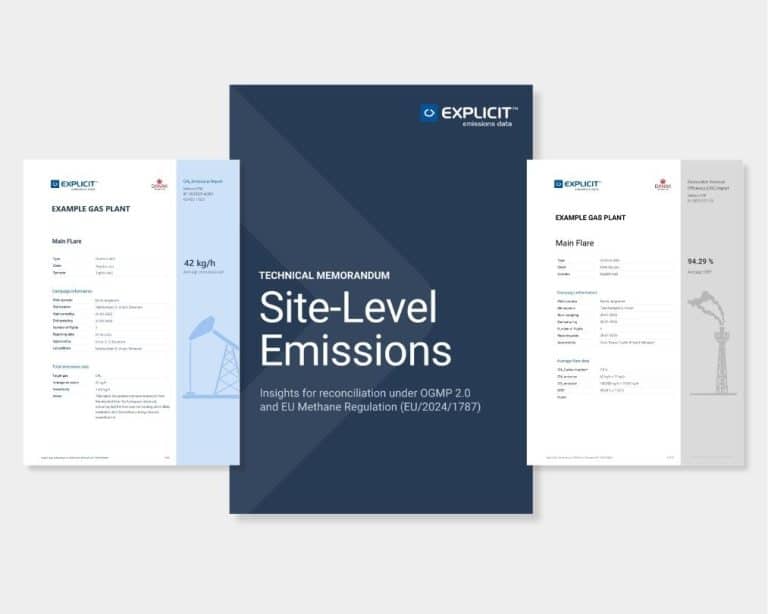
Emissions report
A detailed emissions report containing the average emission rates and visualisations to support source localisation is presented to the client.
Quantification
Data is collected downwind from the site of interest, so that the emission plume is entirely intercepted by the drone. Because both gas and wind data are closely correlated in time and space, Explicit is able to accurately calculate the net emission rate (kg/h) across the inspected area and provide a consistent representation of the flux density of the gas flowing from the site.
Final emission rate is calculated using the data collected during at least 3 flights
20% uncertainty in the final result
Possibility to quantify subsection contributions
Where DFM™ Method can be used
Biogas plants
Isolating and quantifying methane emissions from biogas plants and refineries.
Oil/gas offshore platforms
Quantifying methane emissions from flares, localising leaks and identifying super-emitters from oil/gas production.
Waste water treatment plants
Quantifying nitrous oxide emissions from WWTP, which are often overlooked because of the difficulty in monitoring over water.
LNG Bunkering
Monitoring methane leaks during bunkering processes.
Farming
Monitoring diffuse methane emissions from cattle and pig stables.
Research
Quantifying GHGs reductions when implementing a mitigation action or a new process, or to validate emission factors and models.
Visualisation of data
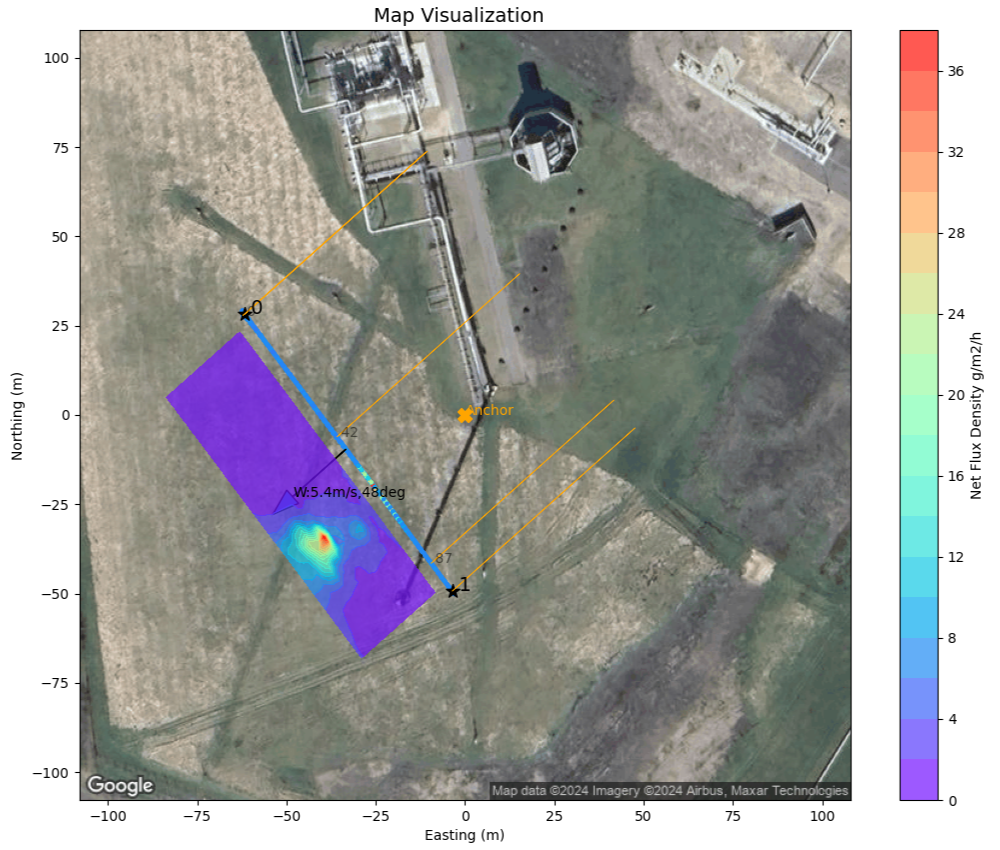
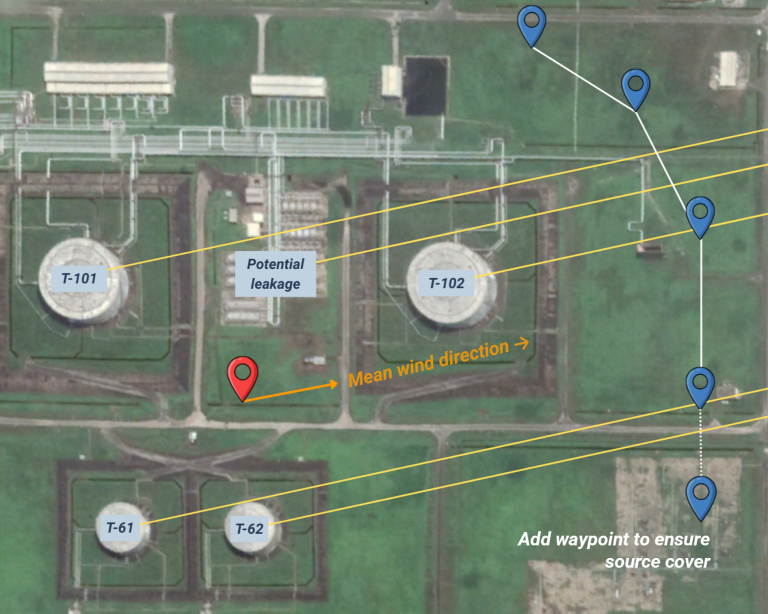
The flight flux density visualisation is plotted on the site map, together with the average wind direction estimated during the flight (orange lines). These visualisations are presented in the emissions report and can support the client in the detection of the sources.
Field-ready emissions monitoring and analytics
Our emissions monitoring technologies and expertise are provided as adaptable service solutions, fitted to the task and the needs of your industry and business.
We offer both fully managed monitoring solutions that cover field operations, data processing, and reporting, and collaborative models where we support local partners with training, sensor payloads, data analysis, and quality control.